
Book Discussion Club: A Point of Support
An online reading and conversation club for teenagers from Russian-speaking families living abroad.
- Pushkin, Chekhov and Zheleznikov - alongside Murakami, Rooney and Adichie
- We learn to put an opinion into words, argue for it and hear the person opposite
- We talk about what matters: identity, emotions, relationships, growing up and choosing your own path
- 5–9 students
- 60 minutes
- once a week
- Zoom, online
- Certificate on completion


- 23 yearsof teaching experience
- 4.9Google rating
- 268Google reviews
Behind the Pygmalion Academy programme is Pygmalion Language Centre, a language centre founded in Latvia in 2003. About the centre
This club is a good fit if your teenager…
Is 14–15 years old and growing up in a Russian-speaking family
Reads and writes at a basic level - that is enough to take part in the conversation
Has something to say but still finds it hard to put their thoughts into Russian




Does your teenager not speak Russian yet?Choose a suitable A1–C1 level course.



About the programme
In our lessons we go from “who am I when I am real” to “I choose to be myself” - through conversations about identity, emotions, other people, relationships, choice and growing up. A lesson lasts 60 minutes, and every conversation has something to lean on: a fragment of a book, a scene from a film and a question for discussion. There is no need to read the whole book beforehand.
In the lesson on self-acceptance, for instance, we read Turgenev, Haig and Strout, watch a scene from “The Perks of Being a Wallflower” and discuss what the character accepts in himself and why it matters.

Identity
Who I am when I am real: the inner voice, self-respect, self-acceptance and the courage to be yourself.

Emotions
What makes an emotion mine: honesty with yourself, emotional steadiness, depth and maturity of feeling.

Other people
People as worlds: motives and histories, masks and expectations, conflict and reconciliation, trust and respect.

Relationships
Closeness, boundaries and responsibility: why we fear love and fear losing ourselves. The anchor text is “Eugene Onegin”.

The world and one’s path
The world as a space of choice and your own path through it: what I want, what stops me and what carries me forward.

Maturity
Inner ground and a freedom that takes others into account. The anchor text is “A Hero of Our Time”. The block ends with a personal manifesto and the final piece of work, after which the teenager receives a certificate.
What we read in class
Cultural grounding
Russian classics on growing up and on choice - fragments and short prose.
- Pushkin’s “The Captain’s Daughter”
- Lermontov’s “Mtsyri”
- Turgenev’s “First Love”
- Chekhov’s short stories
- Zheleznikov’s “Scarecrow”
- Poems by Yesenin and Okudzhava
Wider horizons
Contemporary world fiction on the self and on relationships.
- Saint-Exupéry’s “The Little Prince”
- Haig’s “The Midnight Library”
- Green’s “The Fault in Our Stars”
- Palacio’s “Wonder”
- Murakami’s “Norwegian Wood”
- Rooney
- Strout
- Moyes
- Adichie


What we watch and discuss
At every meeting we watch a short fragment of a film and discuss it. A familiar story makes it easier to start the conversation and move on to the meeting’s main question. We watch “Inside Out”, “Wonder”, “Soul”, “Lady Bird”, “The Perks of Being a Wallflower”, “The Martian” and other films.


What a lesson consists of
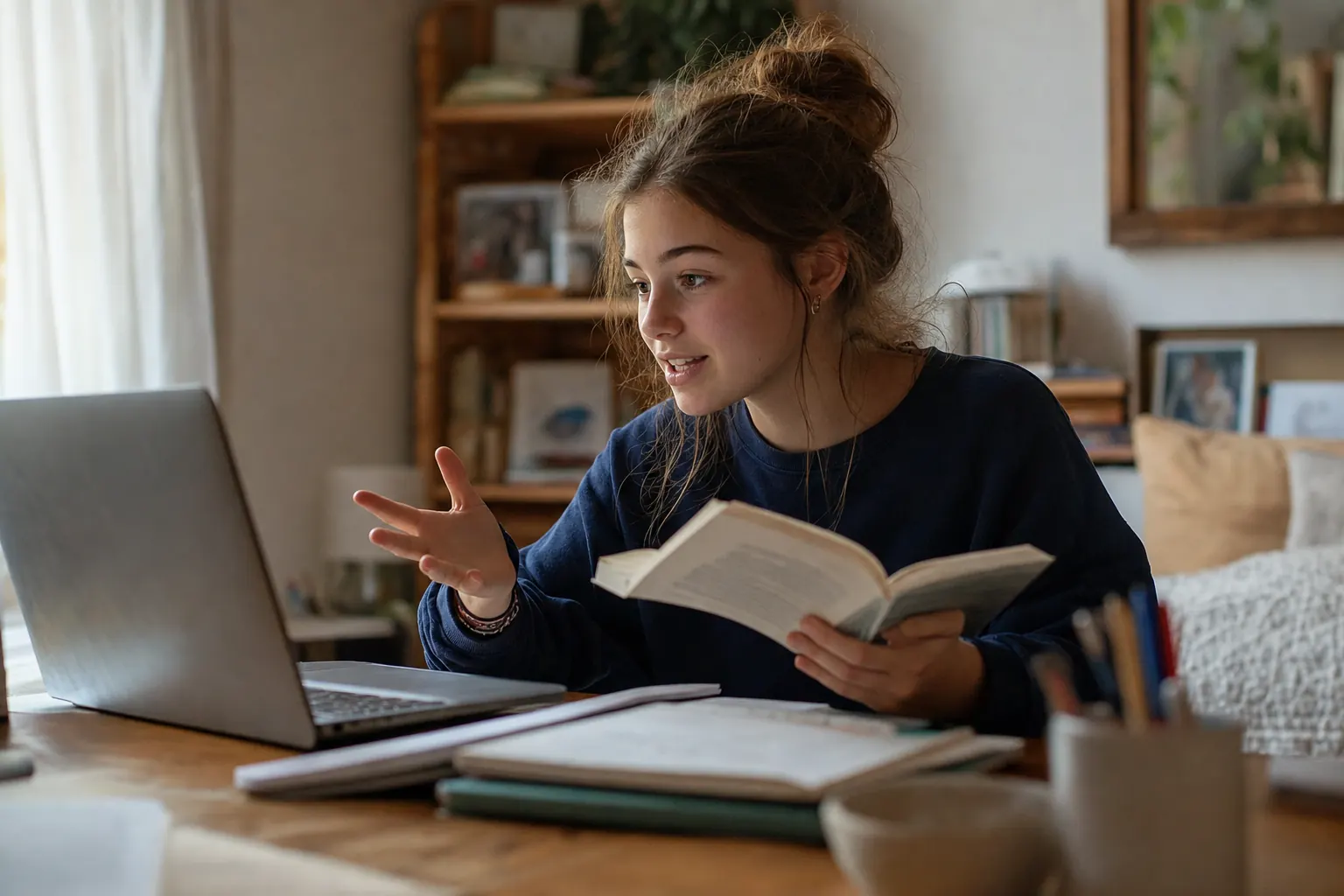
We warm up and meet the topic we are going to discuss
We read a literary fragment - sometimes two: one Russian and one from elsewhere
We watch a scene from a film and do a task in pairs
We discuss the topic with the whole group, share our opinions and do a short piece of writing





How lesson time is divided
- Discussion50%
- Reading20%
- Writing20%
- Film fragment10%

Skills your teenager will develop in the club
- Understands themselves better: their feelings, boundaries and motives
- States their opinion and knows how to argue for it
- Tells complicated emotions apart and learns to cope with them
- Understands other people’s motives and feelings
- Learns to build honest and respectful relationships while keeping their boundaries
- Makes decisions and answers for their choices
- Leads a discussion and knows how to listen
- Writes short essays and texts about their own thoughts and feelings








Teachers
Diana
Teaches the teen courses and club, ages 12–17
- Education
- BA in Philology (University of Latvia), teacher training (Liepāja University)
- Experience
- 20 years of teaching
- Languages
- Russian (native), English, Spanish
- Her students have won prizes at national Russian language olympiads
The more languages a person knows, the brighter and fuller their life becomes.
Raisa A.
Teaches the teen courses and the discussion club - ages 12–17
- Education
- MA in Philology
- Languages
- Russian (native), English (B2)
- Methodology consultant and textbook reviewer
- Takes part in national and international projects
- Also teaches drama and public speaking
I teach because dialogue makes a person free.
Timetable and price
60 €/monthWhy it’s worth keeping Russian
Bilingualism is an advantage
Children growing up with two languages learn to see the world from a broader perspective and easily switch between different ways of thinking.
Russian develops thinking skills
By learning the language more deeply, children learn to express their thoughts more precisely, understand complex ideas, and formulate their own ideas - building intellectual maturity.
A link to culture and family
A language is stories, traditions and the people closest to you. It helps a child feel part of the family and keep their roots.



Frequently asked questions


Enroll your child in the course
An online reading and conversation club for teenagers from Russian-speaking families living abroad.